
The old historic centre of Funchal has become, over recent decades, one of the most striking examples of urban regeneration through art in Portugal.
Between narrow cobbled streets, historic buildings and traditional façades, a project emerged that completely reshaped this area: the painted doors of the Old Town.
The concept is simple, yet the visual and cultural impact is profound. Doors belonging to shops, restaurants and residential buildings were transformed into artistic surfaces.
The result is a continuous open-air gallery where each door acts as a canvas and each street becomes part of a larger exhibition.
Beyond aesthetics, this initiative helped revitalise a previously neglected urban area, with strong involvement from the local community.
Origin of the painted doors project
The urban art project began as part of a wider urban regeneration strategy for Rua de Santa Maria, one of the oldest streets in Funchal. At the time, the area had experienced economic and social decline, creating the need for intervention.
The initial idea was straightforward: encourage shop and property owners to allow artists to use their doors as creative surfaces. The proposal gained gradual acceptance, mainly because it required no major structural changes and offered a low-cost yet highly visible transformation.
Over time, the project grew beyond its local scope and became part of the city’s cultural identity. Tourism interest increased significantly, and the Old Town began to be associated not only with heritage, but also with contemporary urban creativity.
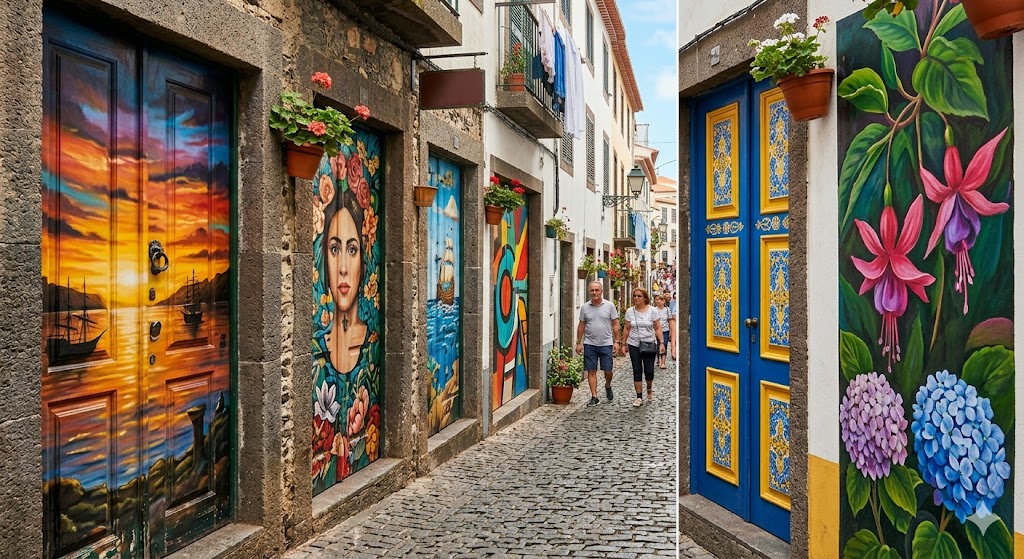
Each door functions as an independent artwork. Some reflect Madeira’s traditions, such as fishing, rural life and local landscapes. Others explore more modern themes, including surrealism, abstraction and social commentary. This diversity created a visually dynamic and ever-changing environment.
Rua de Santa Maria and the Old Town as an open-air gallery
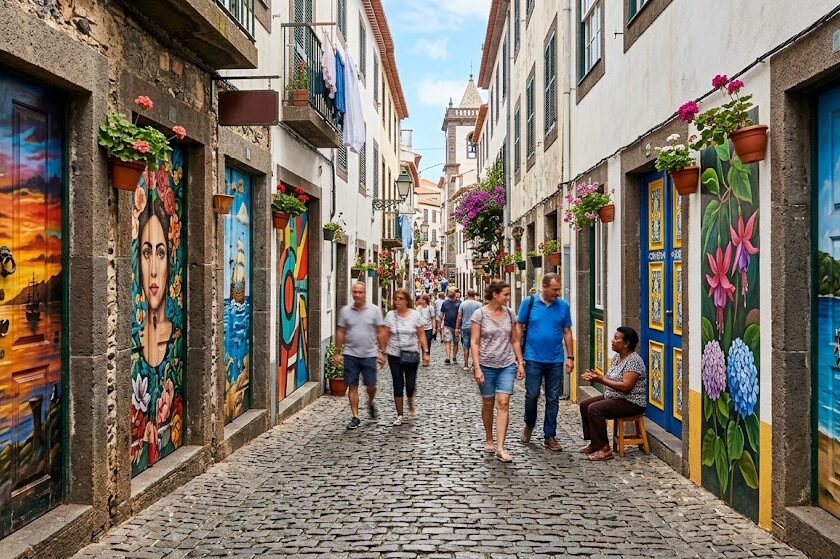
Rua de Santa Maria is the central axis of this artistic route in Funchal. It is a historic street that has evolved into a vibrant space where urban art, restaurants and nightlife coexist.
During the day, natural light enhances the colours and textures of the painted doors.
At night, restaurant lighting and street activity create a more energetic and immersive atmosphere.
What can be seen along the street:
- Doors depicting scenes from everyday Madeiran life (fishing, markets, traditions)
- Works inspired by the island’s ocean, mountains and vegetation
- Abstract compositions with strong colours and bold contrasts
- Hybrid pieces combining tradition and contemporary visual language
The lack of a single dominant style makes the experience unpredictable. Each door offers a new visual surprise, turning the walk into a living gallery.
Artists and styles behind the painted doors
The project involves a wide range of artists, both local residents and international contributors.
This mix of backgrounds is one of the key reasons for the area’s visual richness.
Most common artistic styles:
- Realism → highly detailed portraits and everyday scenes
- Abstract art → exploration of colour, shape and texture without literal representation
- Contemporary street art → expressive works often carrying social messages
- Narrative illustration → visual storytelling rooted in local culture
Some artworks remain in place for years and become iconic references of the street, while others are replaced over time, creating a constantly evolving outdoor exhibition.
Cultural and tourism impact
Urban art in the Old Town of Funchal has had a major impact on the area’s regeneration.
What was once a less visited part of the city is now one of its most popular tourist attractions.
Key transformations include:
- Increased tourist flow to the historic centre
- Restoration and visual improvement of older buildings
- Growth of restaurants, bars and local businesses
- Greater visibility for both local and international artists
Today, the Old Town is a key stop on most visitors’ itineraries, combining historical heritage with contemporary urban creativity in a single space.
Best time to visit and take photos
The experience of the painted doors varies greatly depending on the time of day.
Recommended moments:
- Early morning → soft light and fewer people, ideal for detail observation
- Late afternoon → warmer tones and richer visual depth
- Evening → lively atmosphere with restaurants and nightlife
During peak tourist seasons, Rua de Santa Maria can become quite busy, which may affect both visibility and photography conditions.
What else to visit in the Old Town
The Old Town of Funchal offers much more than painted doors.
Key attractions nearby:
- Traditional restaurants serving Madeiran dishes such as black scabbard fish and espetada
- Small independent art galleries located in historic buildings
- Close access to the Funchal cable car leading to Monte
- Easy connection to Mercado dos Lavradores and the city centre
The combination of gastronomy, culture and urban art makes this area one of the most complete parts of the city.
Practical tips for visiting
- Cobblestone streets can be uneven, so comfortable footwear is recommended
- The area is best explored slowly to appreciate hidden details
- Quieter hours offer a more relaxed and visually clear experience
- A good camera or smartphone helps capture textures and colours
- Side streets also contain less-known but equally interesting artworks
FAQs
What are the painted doors in Funchal?
They are doors in the Old Town transformed into urban artworks, creating an open-air gallery.
Where are the painted doors located?
Mainly along Rua de Santa Maria and surrounding streets in the Old Town of Funchal.
Are the artworks permanent?
No. Some remain for years, while others are replaced, keeping the area constantly evolving.
Is there an entrance fee?
No. Visiting the painted doors is completely free.
What is the best time for photography?
Early morning or late afternoon, due to better light and fewer crowds.