
If you are planning a trip to this stunning island, you have probably been told that the best way to explore it is by renting a car. This is absolutely true.
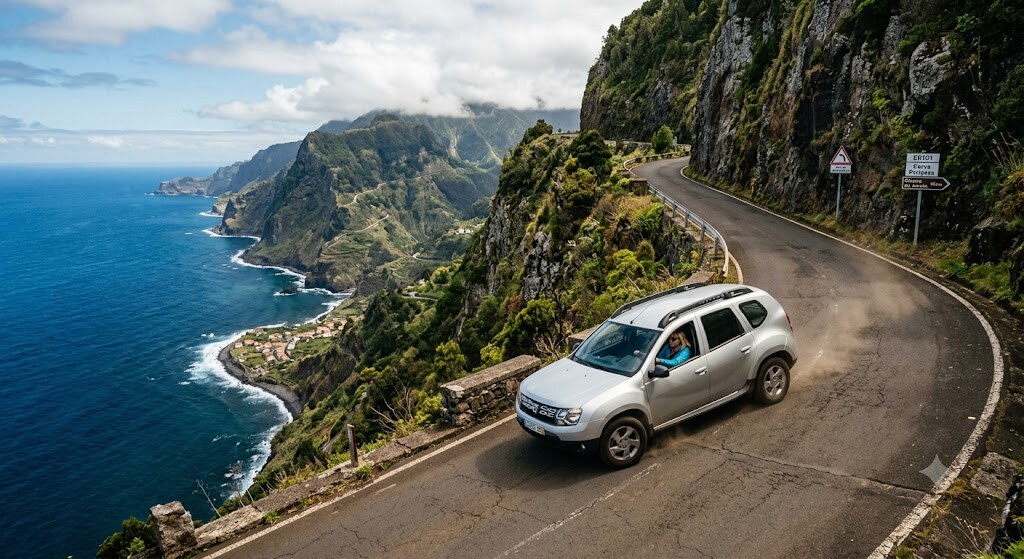
However, it is also highly likely that you have heard horror stories about roads that look like walls, hairpin turns on the edge of cliffs, and pathways so narrow they force you to reverse through banana plantations.
Do not panic. Mastering madeira driving can be a challenge for those used to flat lands or straight mainland highways, but it is far from an impossible mission.
When it comes to madeira driving, it is all a matter of technique, having the right car, and a bit of mental flexibility.
Here is your survival manual to understanding madeira driving like a true local.
1. Choosing the Car: Size and Engine Power Matter
The biggest mistake visitors make when planning their madeira driving adventure is trying to save as much money as possible by choosing the cheapest, lowest-powered model.
- Say “No” to low-power 1.0-litre engines: On a climb up to Curral das Freiras with four people on board and the air conditioning running, an underpowered car will ruin your madeira driving experience by forcing you to ride the clutch until it smokes. Opt for engines with good displacement or, ideally, a turbodiesel or a turbocharged petrol engine.
- Consider an automatic car: If you want a stress-free madeira driving holiday and are not confident with hill starts using a manual clutch, an automatic car will eliminate 90% of your anxiety. The car will not roll back, leaving you free to focus entirely on the steering wheel.
- Choose compact cars: Your madeira driving safety depends heavily on car size. Madeira’s secondary roads and the historic areas of Funchal are incredibly narrow. A giant SUV might feel safe, but it will give you massive headaches when parking or passing oncoming buses.
2. The Art of Mastering Steep Hills
Forget about third and fourth gear on secondary roads. In the world of madeira driving, first and second gear are your best friends.
- Keep the revs high: On the steepest climbs, do not be afraid to hear the engine roar. Keep the car in a low gear and at high RPMs to ensure it has enough power to keep moving upward.
- The “Clutch Bite” and the Handbrake: If your rental car does not have a Hill Assist system, make full use of the handbrake. Stop the car, pull the handbrake up, shift into first gear, accelerate slightly, and, as you feel the car wanting to move forward, smoothly release the handbrake. Take your time. Local drivers know the drill and will usually give you plenty of space.
The Litmus Test: If you can conquer the famous Subida do Comboio in Funchal (one of the steepest residential streets in the city) or the winding climb toward the Cabo Girão viewpoint, you are ready for any other challenge madeira driving throws at you.
3. Downhill Driving: Don’t Melt Your Brakes
What goes up must come down. And driving down a mountain can be just as demanding on the vehicle as driving up, making it a crucial aspect of safe madeira driving.
- Use engine braking: Never coast down a steep slope in “neutral” or with your foot constantly riding the brake pedal. This will overheat the brakes, causing them to lose efficiency (a phenomenon known as brake fade).
- The golden rule: Use the same gear to go down that you would use to go up that exact same stretch (usually second gear). Let the engine slow the car down naturally, and use the brake pedal only for minor adjustments before corners.
The Litmus Test: When driving down from Eira do Serrado toward Curral das Freiras (Valley of the Nuns), you will face consecutive hairpin turns. Keep the car in second gear and let the engine control your descent speed.
4. Old Roads and ERs (Regional Roads)
While the modern highway (VR1) connects most of the island quickly through fantastic tunnels, the true magic of madeira driving lies within the old Regional Roads.
- Watch out for falling rocks: Especially on rainy or very windy days, drive with extra caution on roads carved into the cliffs. It is common to find small debris or rocks on the tarmac.
- Old, unlit tunnels: Unlike the modern tunnels on the highway, some tunnels on the older roads (such as those on the North Coast, along the stretch between Ponta Delgada and Boaventura) are narrow, damp, and lack artificial lighting. Always turn on your dipped headlights and reduce your speed before entering.
- Who has the right of way uphill? By courtesy and unofficial rule, the driver going uphill has priority, as it is much harder to restart a manual car on a steep incline than it is to reverse downhill. If you see a car coming up in a narrow section, pull over wherever you can and facilitate their passage.
5. Golden Tips from the Locals (To Avoid Panic)
- Be careful with GPS: Apps like Google Maps or Waze tend to choose the geographically shortest route. This often compromises your madeira driving comfort by sending you down “veredas” (very narrow rural paths through banana trees, common in Calheta or Ponta do Sol), where the incline can easily reach 30%. If the road looks too suspicious, stick to the main Regional Road (ER), even if it adds 10 minutes to your journey.
- Give buses plenty of space: On the roads climbing up to Monte or Camacha, you will frequently encounter public buses. Local drivers are true steering-wheel artists, but buses need both lanes to swing around certain tight corners. If you see a heavy vehicle approaching a sharp bend, slow down or stop before the turn to give them room to manoeuvre.
- Angle parking: When parking on hills, turn your wheels toward the kerb (if facing downhill) or away from the kerb (if facing uphill). Always leave the car in gear (first or reverse) in addition to pulling the handbrake firmly.
By the end of your first day, you will find that the stress melts away.
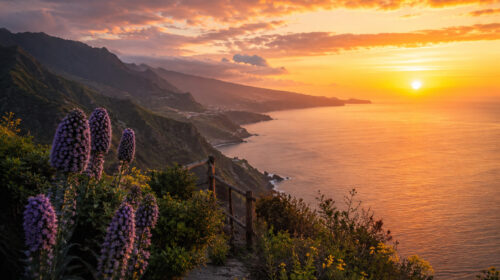
Ultimately, madeira driving requires focus, but it rewards you with some of the most breathtaking landscapes in the world, where the mountains plunge directly into the Atlantic.
Take a deep breath, use your low gears, and enjoy the ride!