
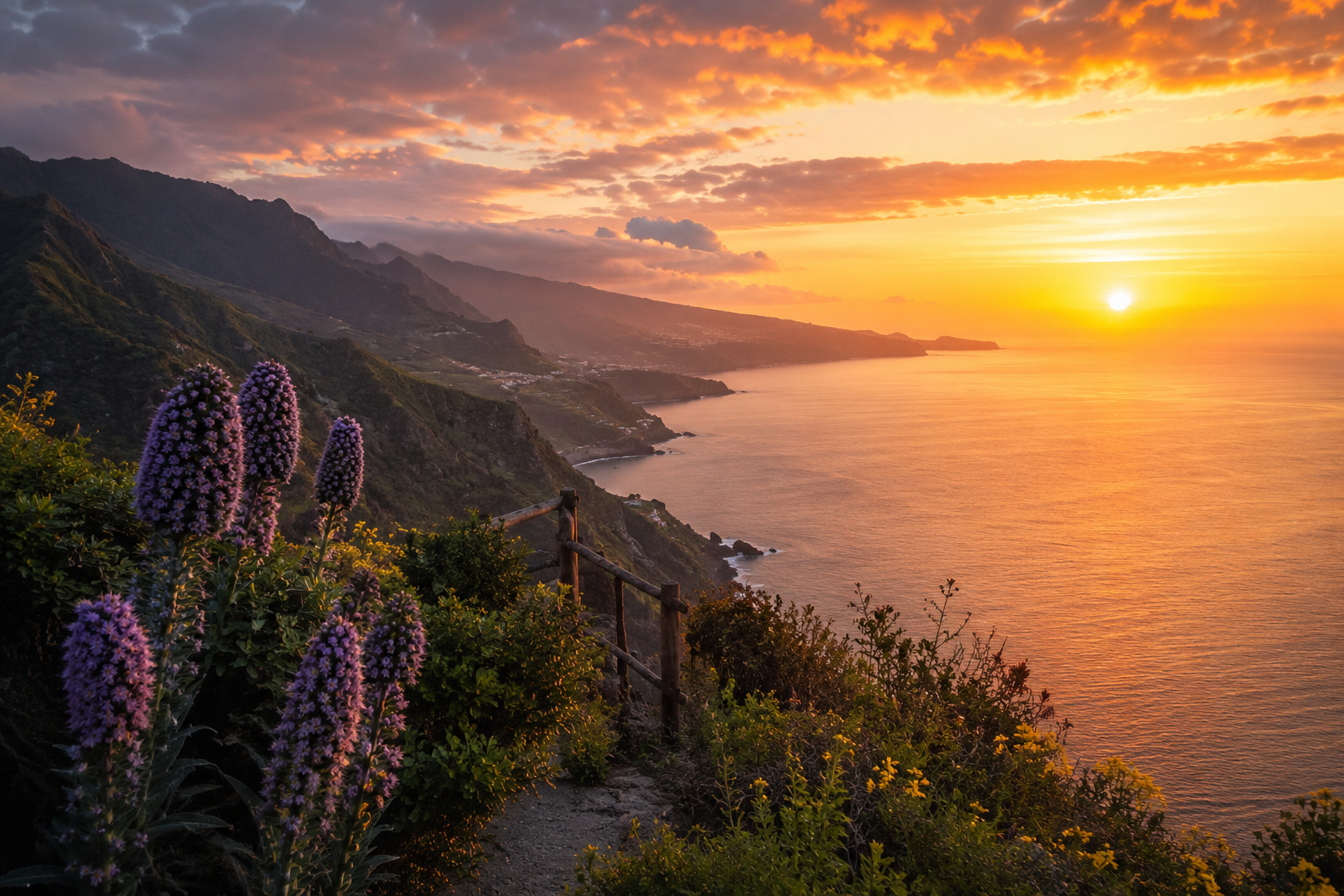
Madeira Island is world-famous for its dramatic landscapes, where colossal mountains dive directly into a deep blue ocean. However, there is one experience that rises above all others—literally.
Watching the sunrise at Pico do Arieiro, the island’s third-highest point at 1,818 meters, is not just a tourist activity; it is a ritual of communion with nature that leaves any traveler in absolute silence.
In this complete guide, we explore everything you need to know to plan this journey, from the logistics of the ascent to the secrets of reaching the best viewpoints.
The Magic of the Moment: What to Expect
The ascent to Pico do Arieiro during the early hours is a sensory experience that begins long before the sun appears.
As your car winds up the roads from Funchal or Monte, civilization fades away and the vegetation changes radically: dense Laurissilva forests give way to resilient heather and bare rock.
The air becomes thinner, the temperature drops sharply, and the sky—far from urban light pollution—reveals a stunning density of stars.
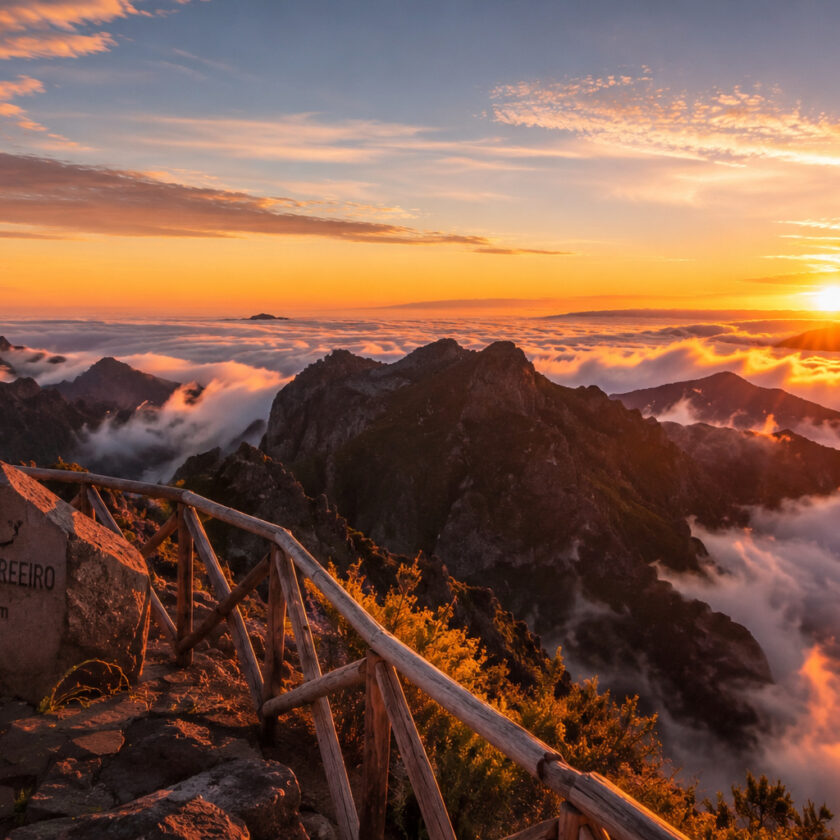
Upon reaching the summit, the scene is often dominated by a “sea of clouds.” This phenomenon occurs when clouds are trapped at a lower altitude due to atmospheric pressure, creating a fluffy white carpet that stretches to the horizon.
When the first rays of sun begin to break through, the sky transforms into a palette of impossible colors: from indigo blue to violet, through electric pink to radiant gold. It is the moment when the clouds seem to catch fire, reflecting the light emerging from the Atlantic.
How to Reach the Best Viewpoints
Many visitors make the mistake of staying only in the parking lot or next to the military radar (the iconic white dome). While the view from there is already incredible, there are specific “spots” that offer a much more immersive perspective.
1. Juncal Viewpoint (The Panoramic East View) This is one of the easiest to access and one of the best for seeing the sun rise directly from the sea horizon.
- How to get there: Upon leaving the parking lot, instead of heading up toward the radar, follow the dirt path that skirts the right side of the mountain (facing East). It is a flat and short walk of about 5 to 10 minutes.
- The View: It offers an open panoramic view over Ponta de São Lourenço and, on exceptional days, allows you to see Porto Santo island. It is the ideal spot for those who don’t want long hikes but wish to escape the radar crowds.
2. Ninho da Manta Viewpoint (The Dramatic Perspective) This is a photographer’s favorite. The name comes from the place where the Buteo buteo (the Madeira buzzard) used to nest.
- How to get there: Go to the summit next to the radar, where you will see the start of the PR1 – Vereda do Arieiro trail (toward Pico Ruivo). Follow the stone steps and narrow path for about 15 to 20 minutes. The path is safe with railings but requires some breath.
- The View: You will be positioned on a natural balcony over the abyss, overlooking the Fajã dos Cortumes valley. Here, the sun illuminates sharp basalt ridges, creating shadows and contrasts that look like an epic movie set.
3. Pico do Arieiro (The Classic Peak) If you have limited mobility or little time, the summit itself, next to the geodesic marker, offers a 360-degree view.
- How to get there: Simply climb the concrete steps from the souvenir shop/cafeteria.
- The View: It is the highest point accessible by car, allowing you to see both the sunrise to the East and the rest of the island to the West, where mountain shadows project onto the clouds.
Logistics: Success Starts the Night Before
For your experience to be memorable for the right reasons, improvisation is your worst enemy.
Check the Weather in Real-Time Madeira has very specific microclimates. It can be raining in Funchal while the sun is shining at the peaks. Before leaving your hotel, check the official Pico do Arieiro webcam (available on the NetMadeira website).
If the image is totally white (thick fog), it may mean the clouds are too high and you won’t have visibility. The ideal scenario is when the webcam shows stars or moonlight above a carpet of fluffy clouds.
The Parking and Driving Challenge In recent years, the popularity of this location has grown exponentially. The main parking lot is limited and fills up early. Plan to arrive at least 45 to 60 minutes before the official sunrise time.
- Driving Tip: The road is in good condition but steep and winding. On the way back, use engine braking (low gears) to avoid overheating the brakes during the long descents.
Essential Gear Do not be fooled by the mild coastal climate. At 1,800 meters, temperatures can be near 0°C even in summer.
- Clothing: Use a layering system. A thermal shirt, a fleece, and crucially, a quality windbreaker. Gloves and a beanie make all the difference while waiting for the sun.
- Snacks: Carrying a thermos with hot coffee or tea is a luxury you will thank yourself for when facing the chilly morning wind.
Photography: Capturing the Moment
Capturing the sunrise presents technical challenges due to the high contrast between intense light and deep shadows.
- Tripod: Essential if you want to take long-exposure photos before dawn or timelapse videos.
- HDR Mode: On your phone, ensure HDR mode is active to balance the sky’s brightness with the dark mountains.
- Human Scale: Ask someone to stand on the edge of a viewpoint. Having a person in the composition helps convey the monumental scale of the mountains and the sea of clouds.
What to Do After the Sun Rises?
Many tourists make the mistake of driving back down as soon as the sun is up. However, the hour that follows—the “golden hour”—is when the landscape reveals its best textures.
Explore part of the PR1: You don’t need to do the full 7 km to Pico Ruivo (a demanding 4-hour hike). Walking just the first 20 or 30 minutes will allow you to pass through the famous “Stairway to Heaven” (a narrow trail section with views on both sides) and through tunnels carved into volcanic rock.
Visit the Cafeteria: When the visitor center opens, enjoy a second breakfast. The building has interesting architecture that blends into the landscape and offers shelter if the cold becomes too much.
Safety and Sustainability Summary
Madeira takes pride in its virgin nature, and Pico do Arieiro is part of the Madeira Natural Park.
- Respect the Railings: Do not jump fences to take photos. Basalt rock can be brittle, and falls are fatal.
- Leave No Trace: The high-altitude ecosystem is fragile. Take all your trash with you, including organic waste like fruit peels.
- Wildlife: You might see the Zino’s Petrel, an extremely rare seabird that nests in these mountains. Respect their habitat and avoid excessive noise.
Concluding your morning at the top of the island is feeling the pulse of the Earth. It is a reminder of our smallness against the grandeur of geology and the cosmos. The lost sleep will be quickly compensated by the sight of the first ray of sun touching the clouds, a spectacle that no screen can truly replicate. It is, without a doubt, the “crown jewel” of any visit to Madeira Island.
Frequently Asked Questions (FAQs) – Sunrise at Pico do Arieiro
What time should I leave Funchal? It depends on the time of year. You should check the official sunrise time and aim to arrive at the summit 45 to 60 minutes before. Generally, this means leaving Funchal between 05:30 and 06:30 AM. The drive takes approximately 40 to 50 minutes.
Do I need to pay for entry or parking? No, access to Pico do Arieiro and its viewpoints is free of charge. Parking is also free, but spaces are limited and fill up very quickly as sunrise approaches.
How can I check if the weather is good at the summit? The most reliable way is to check the real-time webcam at Pico do Arieiro via the NetMadeira website or app. It is very common for it to be raining on the coast while the sky is perfectly clear above the clouds at 1,800 meters.
Is it very cold up there? Yes! Even in the height of summer, temperatures can hover around 5°C (41°F) or lower before the sun rises, often accompanied by strong winds. It is essential to bring a windbreaker, warm layers, and ideally, a beanie and gloves.
Are there toilets and cafes available? There is a visitor center with a cafeteria, souvenir shop, and restrooms. However, these facilities usually open at 09:00 AM. If you arrive early for the sunrise, everything will be closed.
Can I get to Pico do Arieiro without a rental car? Yes. Several tour companies organize specific sunrise transfers. You can also take a taxi or use ride-sharing services, though the cost will be significantly higher. There is no public transport (bus) that goes all the way to the summit.
Is it safe to walk the trails in the dark? Yes, as long as you stay on the marked paths and use a flashlight (your phone’s light is sufficient for short distances). The paths to the Juncal and Ninho da Manta viewpoints are protected by railings, but you should exercise extra caution as the ground can be slippery due to morning mist.
Is it worth going if it is cloudy? If the clouds are below the peak (the famous “sea of clouds”), it is the best time to go. However, if the webcam shows thick fog at the radar station itself, visibility will be zero and the experience may be disappointing.